Police Funeral Honors for Active and Retired Officers: A Family Guide
Police Funeral Honors for Active and Retired Officers: A Family Guide
Intro
When a loved one has served in law enforcement, their final farewell often carries a meaning that goes beyond an ordinary funeral. Whether they were an active officer who passed away from illness, an off-duty emergency, or natural causes, or a retired officer who dedicated decades to public service, many families wonder what honors may be available.
Police funeral traditions vary by department, city, county, and state. Some honors are reserved for line-of-duty deaths, while others may be offered to active, off-duty, former, or retired officers with approval from the department and the family. The purpose of this guide is to help families understand the most common traditions and prepare for the conversation with the funeral home or police liaison.
Are Police Funeral Honors Only for Line-of-Duty Deaths?
No. Full ceremonial honors are most commonly associated with officers killed in the line of duty, but many departments also provide some level of honor for active officers who die off duty, officers who pass from illness, and retired officers.
The exact protocol depends on the department. For example, some police funeral procedures distinguish between line-of-duty deaths, active-duty deaths, off-duty deaths, and retired personnel, with different levels of ceremonial participation for each category. Some departments officially participate in funerals for both active and retired members when the family approves it.
Funeral Honors for Active Officers Who Die From Illness or Natural Causes
An active officer may pass away from cancer, a heart attack, a stroke, an accident outside duty hours, or another non-line-of-duty cause. These losses are still deeply felt within the department. The officer was still part of the law enforcement family, still carried the badge, and may still be eligible for ceremonial recognition.
Common honors may include a uniformed presence, honor guard participation, a police escort, department chaplain support, a flag presentation, or a final radio call, depending on local policy and department approval. Some protocol documents specifically include categories for active sworn personnel and deaths that are not line-of-duty deaths, because apparently even grief needs paperwork and subcategories.
Funeral Honors for Retired Police Officers
Retirement does not erase a lifetime of service. Many departments and police associations recognize retired officers with a ceremonial presence, flag or badge tribute, honor guard support, chaplain support, or a final acknowledgment of service.
The important practical difference is that retired officer honors may not happen automatically. Families often need to contact the department, retired officers’ association, pension board, union, or sheriff’s office to ask what is available. Some official protocols state that retired officers may receive funeral honors, often with approval from the chief or department leadership.
The End of Watch Call or Last Radio Call
The End of Watch call, also called the Last Radio Call, is one of the most emotional law enforcement funeral traditions. A dispatcher broadcasts a final call over the radio, naming the officer and acknowledging their service. In many ceremonies, the officer’s badge number or unit number is called, followed by silence, and then a final message of farewell.
Although many people associate the End of Watch call with line-of-duty deaths, the tradition may also be used for officers who died from illness or for retired officers, depending on the department. Some public safety procedures use last-call announcements for line-of-duty deaths, retirements, and certain former or current responders.
The Flag Presentation and Badge Tribute
A flag may be draped over the casket or displayed near the urn during the service. At the end of the ceremony, officers or honor guard members may fold the flag and present it to the next of kin.
For retired officers or officers who died outside the line of duty, the exact wording and ceremony may vary. Some families may also include a badge, framed photograph, service record, commendations, or department patches as part of the memorial display.
The Police Escort and Honor Guard
A police escort may accompany the funeral procession from the service location to the cemetery or final resting place. Honor guard members may stand watch, escort the casket, fold the flag, or participate in a graveside ceremony.
Not every family wants a large public procession, and not every department can provide the same level of support. A smaller honor guard presence can still feel deeply meaningful, especially for retired officers or officers who served quietly for many years.
What Families Should Prepare Before Contacting the Department
Families can make the process easier by gathering:
- Full name and rank.
- Badge number or unit number.
- Department name and years of service.
- Retirement date, if applicable.
- Awards, commendations, or special assignments.
- A preferred photo in uniform.
- Funeral home contact details.
- Service date, time, and location.
The best first contact is usually the department liaison, chaplain, honor guard coordinator, union representative, retired officers’ association, or funeral director.
A Memorial Program Can Help Preserve the Officer’s Story
For many families, the printed or digital memorial program becomes more than an order of service. It becomes a keepsake. For police families, it can include the officer’s badge number, End of Watch date, years of service, department honors, family photos, favorite memories, and a written tribute.
This is where we can place the product softly, sin meterle un cartel de neón en mitad del duelo, que tampoco somos una máquina tragaperras con Canva.
A Thoughtful Memorial Template for Law Enforcement Families
If you are preparing a farewell for an active-duty, off-duty, or retired police officer, our editable Law Enforcement Memorial Booklet was created to help families honor a lifetime of service with dignity.
The template includes space for the officer’s photo, badge number, End of Watch tribute, order of service, family memories, department honors, and personal messages. It is fully editable in Canva and can be customized for active officers, retired officers, police veterans, sheriffs, deputies, and law enforcement families.

Police Funeral Program Template
Editable 8-page police funeral booklet for honoring an officer with service details, photos, tribute text, and memorial sections.
View Template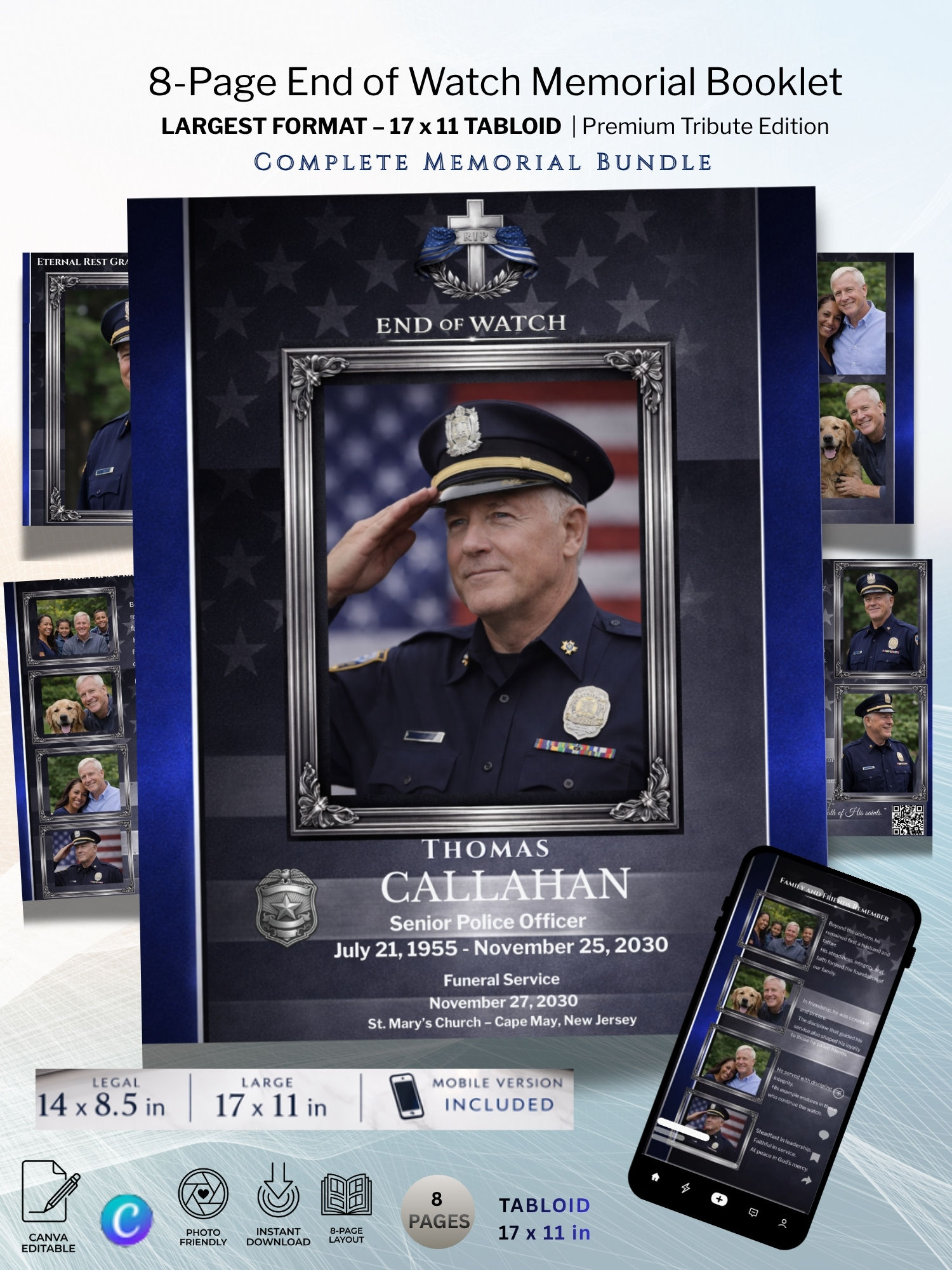
End of Watch Memorial Booklet
A dignified memorial program for police families, with space for the End of Watch tribute, badge number, and family memories.
View Template
Retired Police Officer Memorial Template
Editable memorial design for celebrating a retired officer’s years of service, department legacy, badge history, and personal story.
View Template

Comments
Post a Comment
Gracias por tu comentario